QR Stickers · August 22, 2026
Why does my content feel like an ad?
When every post sells, nothing earns attention. How to spot ad-like content, and what to make instead.
QR Stickers · August 22, 2026
When every post sells, nothing earns attention. How to spot ad-like content, and what to make instead.
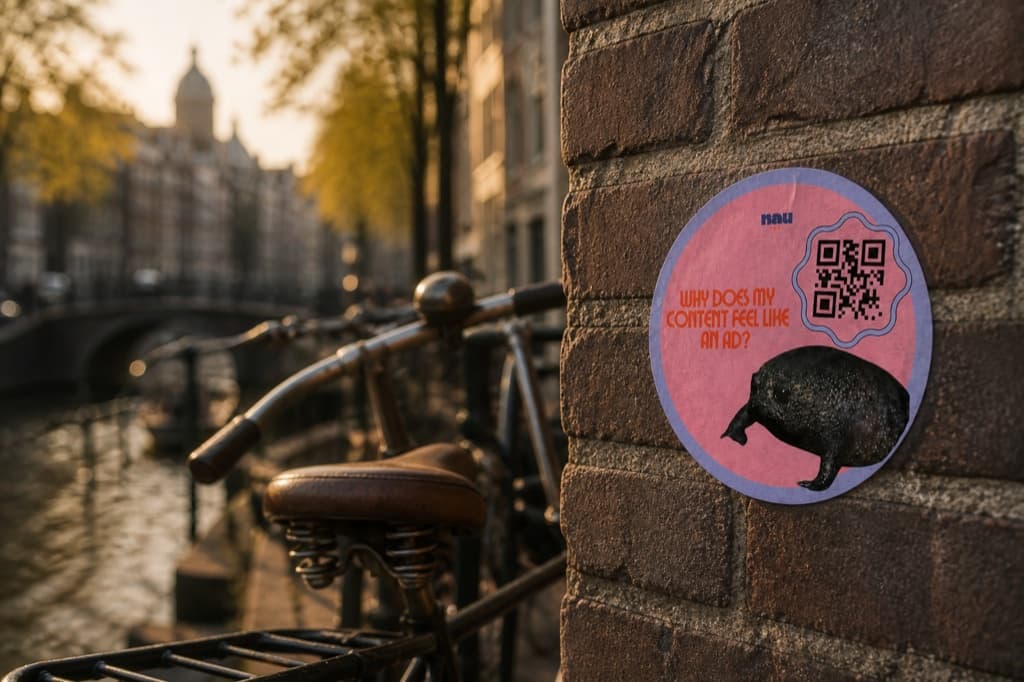
You found this through a NAU sticker. The question landed because you already feel it: the post is polished, on-brand, and somehow still ignored. Like a very expensive pamphlet that learned to dance.
Content feels like an ad when the audience can finish your sentence before you do. The camera announces “campaign.” The caption announces “buy.” The viewer’s brain, which has survived decades of this sort of thing, files it under skip and goes looking for something that might be interesting.
| Moment | Bad (ad-like) | Good (worth watching) |
|---|---|---|
| Opening frame | Logo, then product spin | A recognisable problem or moment first |
| Caption | Feature list + shop link | One honest tension; product arrives later |
| Proof | “Premium quality” with no context | Field use, constraint, customer voice |
| Ask | Buy now on every post | One clear next step when the story earned it |
**Bad outdoor brand:** three angles of a jacket on a white cyclorama, soft piano, caption that begins with “Introducing.” It is not wrong so much as it is already over. The viewer has seen this film before, starring different logos.
**Good reference:** Patagonia’s Worn Wear films. The product appears, but the plot is repair, longevity, and people who keep using gear past its marketing shelf life. The jacket is a character, not the narrator yelling its own name.
**Bad hotel content:** endless room tours that compete with every OTA listing on earth. **Good hospitality content:** how a guest actually spends a slow morning in the neighbourhood. Same budget. Different reason to stay for the ending.
Nielsen Norman Group has shown for years that people scan for relevance, not polish. Relevance is a story job. Polish is a finishing job. Do them in that order and your content stops feeling like an ad that wandered into the wrong party.
Continue reading
A complementary essay from the same thread.
Swipe left for next, right for previous.
Up next · QR Stickers
Most drop-off is not a bug. It is a story that stopped making sense. How to find the stuck step and fix it.
Read essay →Let the right audience find you through one connected campaign. That's the impact we build together.

Stefani Dimitrova
Organic GTM & Product Storyteller