Content · August 7, 2026

Your best campaign might not start on a screen

Why some of the most effective campaigns begin where Wi-Fi is least relevant.
Your best campaign might not start on a screen

I have watched founders spend six figures on ads before they have spent six minutes in the same room as a customer. The dashboard looks busy. The brand still feels theoretical. That is not a media-buying problem. It is a starting-point problem.

The best marketing does not always start behind a screen. Sometimes it starts on a pavement, in a queue, at a market stall, in a pop-up that lasts one weekend. Not because “offline is trendy,” but because trust is still built where bodies share space. Screens amplify belief. They rarely create it from nothing.

This piece is about physical-first campaigns: when to begin offline, how to design experiences that transfer credibility online, and how to avoid treating the real world as a costume for a digital strategy that was never believed in the first place.

What screens are good at-and what they are not

Digital channels are excellent at reach, targeting, iteration, and measurement. They are poor at manufacturing the feeling that something is real. A polished feed can signal competence. It cannot easily signal that strangers have already taken a risk on you in public.

  • Screens scale messages. Rooms scale conviction.
  • Ads rent attention. Presence earns memory.
  • Metrics prove activity. Shared experience proves seriousness.
  • Online can explain the offer. Offline can make the offer feel inevitable.

I am not anti-digital. I build websites for a living. I am anti-sequence: starting where belief is cheapest to fake, then wondering why conversion feels expensive. If your product story still feels like a slide deck, more impressions will not fix the texture problem. Related: why every startup looks like a marketing problem until you dig deeper.

Why physical-first campaigns still win for trust

Trust is partly informational and partly social. People need to know what you do. They also need to feel that other people like them have already accepted the risk. Physical presence compresses that social proof into something hard to counterfeit: queue, touch, smell, inconvenience endured together, a queue that was not empty.

Experiential marketing works when it is designed as a belief system, not a photo opportunity. The question is not “will this look good on Instagram?” The question is “will someone leave able to explain us to a friend without a brochure?” If the answer depends on a caption, you built a set. If the answer is a story they lived, you built marketing.

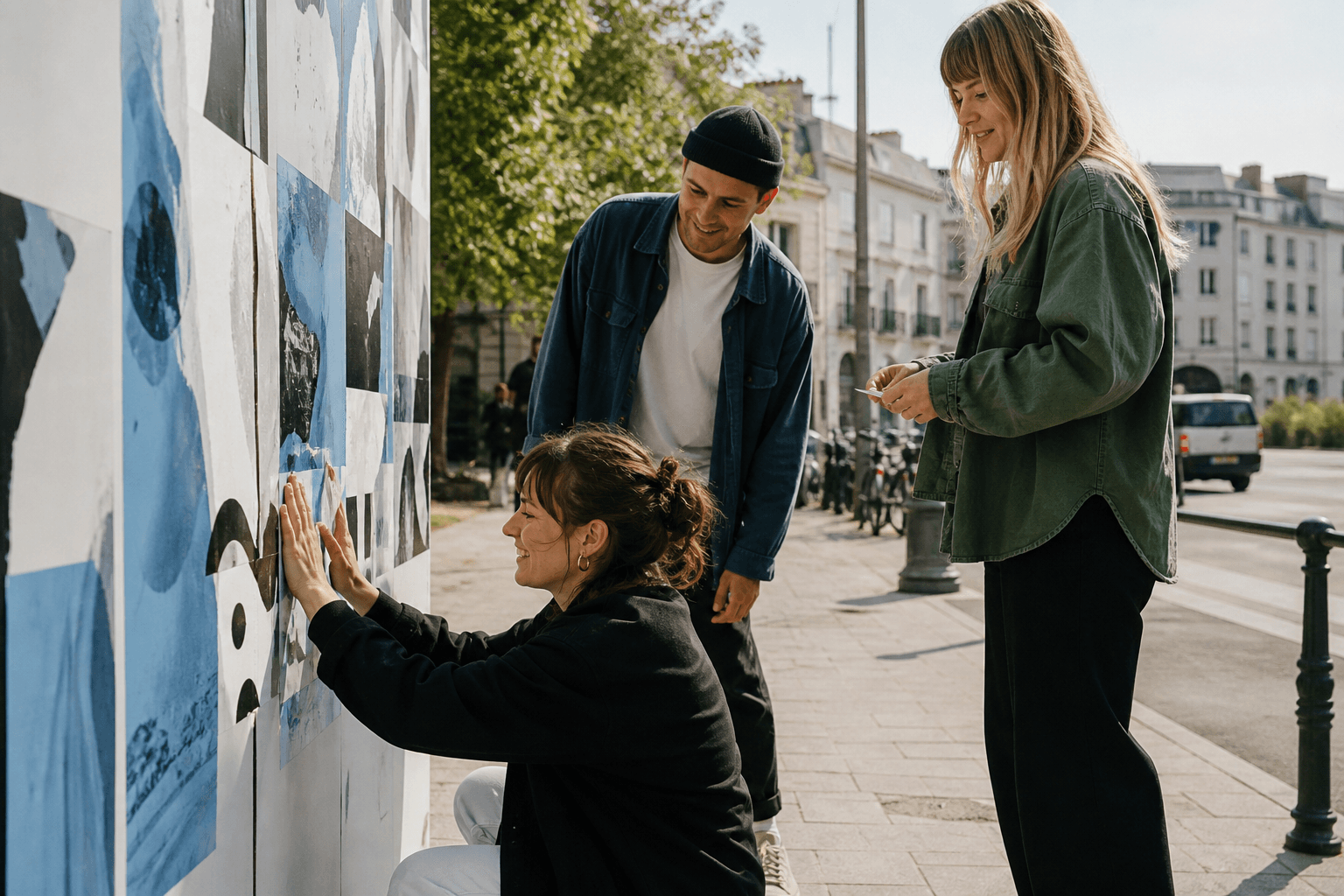
People gathered around a physical brand experience away from screens
Starting behind a screenStarting in the worldWhat changes
Awareness firstPresence firstYou earn a story before you buy reach
Claim → click → hopeExperience → story → shareCredibility precedes conversion asks
Creative as persuasionCreative as environmentThe brand becomes a place, not a post
Optimise CTROptimise talkabilityWord of mouth becomes the secondary channel
Cheap to launch, expensive to believeHarder to launch, cheaper to believeUnit economics of trust improve
If your campaign only works when nobody has to show up, you have built content-not marketing.

A framework: presence → proof → capture → amplify

1. Presence: choose a real constraint

Pick a place, a time window, and an audience that can actually arrive. Constraints are not a budget limitation here-they are the product. A weekend stall at a specific market is more believable than a “global launch activation” that is really a rented studio and a ring light.

Ask: Who already gathers here? What job are they trying to do in this place? How does our offer interrupt that job usefully rather than rudely? If you cannot answer those three, you are decorating a location, not designing presence.

2. Proof: make the outcome visible in public

Physical marketing should demonstrate something. Sampling, live demos, before/after, co-creation, a queue that resolves a small problem on the spot. Invisible value in a visible place is a missed opportunity. Visible value in an invisible place is just a private demo with better lighting.

  • Show the transformation in under three minutes.
  • Let bystanders observe without committing.
  • Give participants a artefact they can take away (physical or digital).
  • Design one moment worth describing at dinner.

3. Capture: turn presence into a relationship

Offline without capture is charity for your ego. Design a low-friction bridge: QR to a specific landing page, SMS keyword, appointment booking, waitlist with a clear next step. The bridge should continue the same promise-not dump people into a generic homepage that contradicts the experience. For how that coherence works, see when marketing feels like product design.

4. Amplify: distribute lived proof, not stock energy

After the event, digital is no longer inventing reality. It is documenting it. Short clips of real reactions, founder notes from the day, photos that include mess and context, quotes that sound like humans. Amplification that looks too clean often underperforms amplification that looks true.

When offline should come first

Not every brand needs a street campaign. Offline-first is especially useful when: the category is crowded with identical ads; the purchase involves social risk; the product benefits from sensory proof; local density matters more than national reach; or your digital creative keeps getting polished while conversion stagnates.

It is less useful when your audience is geographically sparse, the offer is purely informational, or you do not yet have a clear promise. Throwing a party for an unclear product is an expensive way to confirm nobody knows what you do. In that case, fix clarity first-your product may not have a marketing problem.

Examples: physical-first done with intent

Glossier’s early community events and store experiences were not “offline vanity.” They were distribution for a beauty brand that needed social proof and belonging. Pop-ups for consumer brands work when the store is a demo of the brand system-not a temporary shelf. Even B2B can learn: invite-only dinners, workshop mornings, and live teardown sessions create denser belief than another LinkedIn carousel.

A fictional contrast: “Nimbus,” a meal-kit startup. They run Meta ads with lifestyle photography for three months. CAC rises; retention is soft. Then they spend one Saturday at a neighbourhood market with three recipes, a chef, and free samples that require a QR for the first box discount. They leave with fewer impressions and more conversations that sound like customers. The digital spend that follows finally has something true to say.

Budget without the theatre

Founders often assume offline means expensive. It can. It can also mean a table, two people who understand the product, and a designed conversation. The cost that matters is opportunity cost: months of ads teaching the market a fuzzy story versus one weekend teaching fifty people a sharp one.

  1. Allocate a fixed small budget for one constrained physical test before scaling paid social.
  2. Define success as conversations and captured next steps-not footfall vanity.
  3. Script the first thirty seconds so volunteers do not improvise your positioning away.
  4. Photograph and record with consent as documentation, not as the primary goal.
  5. Debrief the same week: what people repeated, objected to, and asked next.

How to measure without killing the magic

Measure what offline is for. Track unique capture rate, cost per meaningful conversation, show-up rate to the next step, and qualitative language people use. UTM everything you can without turning the experience into a clipboard interrogation. Attribution will be messier than a pixel. Belief was always messier than a pixel.

MetricWhat it tells youTrap to avoid
Conversations per hourWhether the offer is legible in publicCounting flyers handed out as success
Capture rateWhether the bridge worksLong forms that kill momentum
Next-step completionWhether belief survived the nightVanity email opens without intent
Phrase repeatsWhether your story is portableIgnoring objections as “noise”
Amplification engagementWhether lived proof travelsOver-producing content that looks fake

If you are deciding where the first £1,000 should go, read where startups spend their first £1,000 in the wrong place. If you are about to scale spend without a belief system, read before you spend £10,000 on marketing.

What research and craft sources are useful for

For experiential and brand-building craft beyond vanity metrics, Harvard Business Review regularly covers experience design and trust. Eventbrite’s blog and Campaign document what works in live activations when you filter for substance. For behavioural foundations of social proof, Nielsen Norman Group remains useful even when the interface is a street corner. None of these replace standing where your customers already stand.

How this shows up in my work at nau

I care about systems more than stunts. Offline is not a rebellion against digital-it is often the missing layer that makes digital honest. When I help founders design growth, I ask where belief is created, not only where it is advertised. Sometimes that answer is a page. Sometimes it is a pavement.

If you want the systems lens, read why I care more about systems than campaigns. If you keep buying more marketing when you need clarity, start with what founders actually need isn’t more marketing.

Isn’t offline hard to scale?

Yes-and that is partly the point. Scale belief after you have created it. Offline creates density; digital creates distribution. Confusing those jobs is how brands become loud and forgettable.

What if our customers are mostly online?

Then use smaller physical moments-dinners, workshops, meetups-or partner with places they already trust. “Online customer” does not mean “customer who has never been in a room.”

How do we start with almost no budget?

One table, one clear demo, one capture link, two people who can explain the product without slides. Constraint is a feature. Spectacle is optional.

Won’t we look small compared with polished ads?

Looking small and real often outperforms looking large and hollow. Audiences are fluent in polish. They are hungry for proof.

Start where belief is hardest to fake

The best marketing does not always start behind a screen because the best marketing starts where the audience can test whether you are serious. Design presence. Make proof public. Capture the relationship. Then let the internet do what it does best: carry a true story farther than your feet can.

Want help designing a physical-first campaign that makes your digital marketing more believable?

Talk about your growth system

Let the right audience find you, with 10 videos only. That's the progress we build together.

Stefani Dimitrova

Stefani Dimitrova

Organic GTM & Product Storyteller